Set it up once. That's the product.

Your own streaming service.
It just works.

Lunaris turns your Mac into a private media server in about fifteen minutes — then keeps it running so you never think about it again. Every file yours. No subscription.

Buy Lunaris · $29What's included

One-time $29 for the first 100 licenses · then $59 · 14-day money-back guarantee

One minute. One Mac. Eleven services, running themselves.

PlexJellyfinSonarrRadarrProwlarrqBittorrentSeerrBazarr

The same tools power users spend a weekend wiring together, wired for you in one click.

any given 11 PM

Self-hosting media has always meant doing it the hard way.

Everyone who's tried this knows the drill: a 4,000-word guide, Docker, six containers each with its own way to break, an hour fighting the VPN. And then it works. For a while.

Then you sit down on a Friday to watch something, and it won't play. A download stalled at 99%. A service crashed overnight. An update changed a setting and nothing talks to anything anymore. Now you're troubleshooting at 11pm instead of watching the movie you sat down for.

The tools are great. The work of running them never stops. Lunaris takes that over, so the next time you sit down to watch, it just plays.

From download to movie night, one afternoon.

4:00 PM

Download it. Open it.

One signed Mac app. The setup wizard makes every technical decision — runtime, VPN, quality profiles, subtitles. You pick Plex or Jellyfin and sign in.

Lunaris
15 MIN
4:20 PM

Add the first few movies.

Browse inside Lunaris or add from your watchlist on any device. Downloads run sealed behind the VPN and file themselves, subtitled and organized.

Installing stack
Configuring VPN
Building library
2 CLICKS
9:00 PM

Couch. Remote. Play.

Your library looks like a streaming service on the TV — posters, resume-where-you-left-off, every screen in the house. Except nothing in it expires.

$0/MO

4:02 AM

While you slept.

The night shift is the product.

A self-hosted stack decays the moment you stop tending it. So Lunaris tends it: it recovers stalled downloads, restarts whatever crashed, applies updates behind a health check and rolls back any that fail, and keeps two weeks of config backups.

Every line in this log is a real, shipping behavior. If you're watching something at 4 AM, it waits for you to finish.

lunaris · night shifton watch
01:14download stalled at 99%, watchdog resumed itok
02:37sonarr crashed, restarted cleanok
02:38vpn kill switch verified, no leaksok
04:002 container updates applied behind a health checkok
04:00someone was watching, so the disruptive part waitedok
04:01config backup written, fourteen days keptok
04:02library verified, all quietok

The skeptic's timeline

"These setups always
die in a month."

Everyone knows someone whose home server lasted three weekends. The entire point of Lunaris is how this conversation ends: the setup that took one sitting is still running a semester later, untouched.

  • Crashes restart and stalled downloads resume on their own
  • Updates apply behind a health check — and roll back if they fail
  • The menu bar crescent is all the checking-in most weeks get
Saturday 4:12 PM
ok bought that lunaris thing. wizard says 15 min, we'll see
…ok that was actually it. it's downloading already??
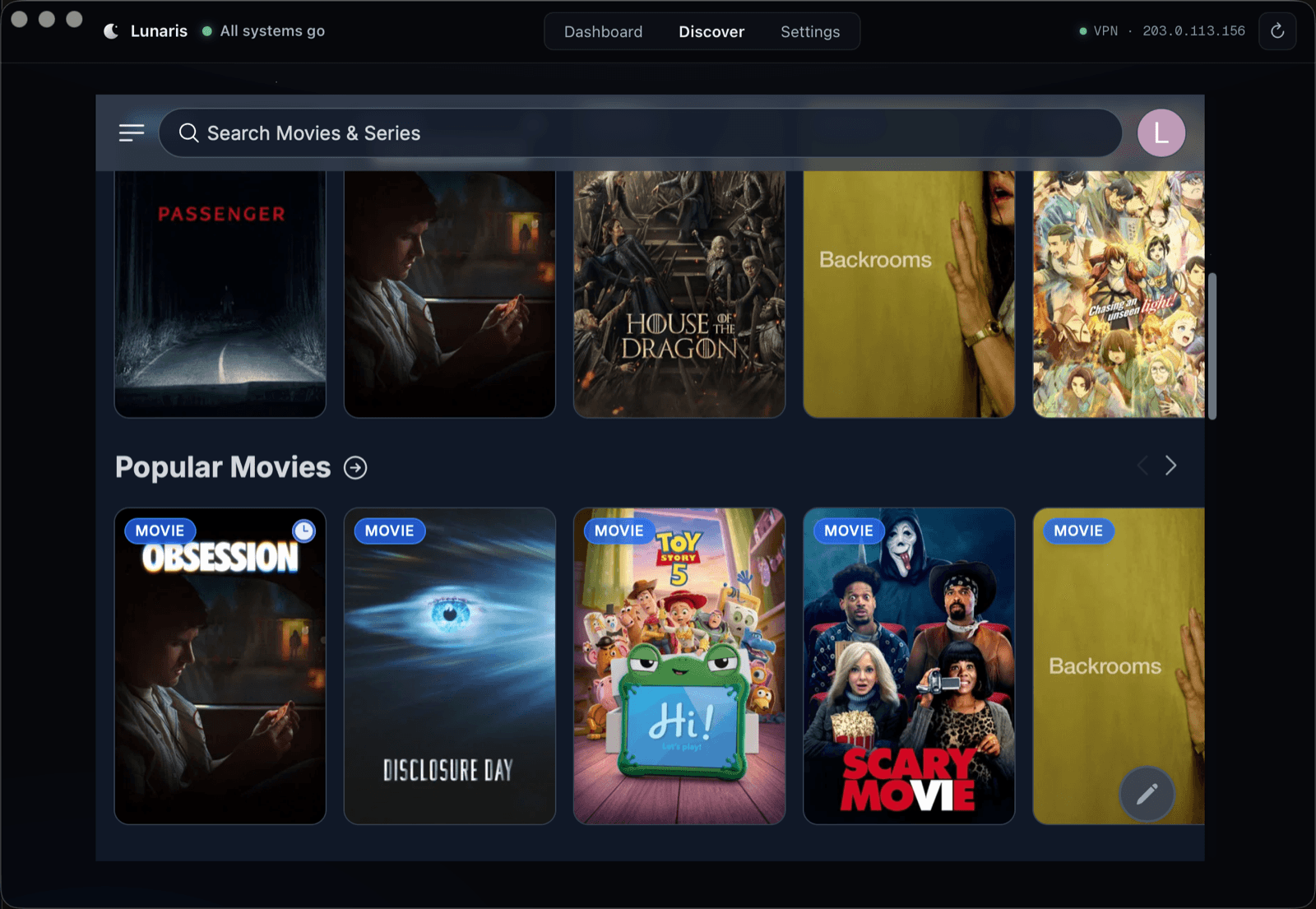
The Lunaris Discover tab, browsing movies minutes after setup
Saturday 9:04 PM
wait how are you watching this. did you get plex pass
nope. my mac runs the whole thing now. one-time $29
no way it keeps working. these setups always die in a month
Three months later
ok your movie server survived the semester. send the link
getlunaris.app 🌙
Read 9:41 PM

Streaming apps charge monthly to rent. This is $29 to own.

$29
once · first 100 licenses · then $59
every update included · 14-day money back
Buy Lunaris

One app, the whole stack.

Nine services, one hand on all of them. Lunaris runs the whole stack and holds every piece in conversation.

Auto-heal · live
Sonarrrestarted
Downloadsresumed
VPNreconnected

Fixes itself

A crashed service restarts, a stalled download recovers, and if your VPN provider goes down, Lunaris can switch to your backup credentials on its own — all before you notice.

Installing the stack83%
PlexSonarrRadarrVPN+2

One-click everything

Every service arrives already talking to the rest: indexers feed the library, subtitles find their episodes, requests flow straight to downloads.

VPNprotected
Downloadsencrypted
Kill switchON

Private by default

Every download rides an encrypted VPN, sealed by a kill switch: if the tunnel drops, the downloader goes silent instead of falling back to your real connection. Set up for you, always on.

Dune: Part Two
Dune: Part Two
2024 · 4K
Added

The whole house can ask

Browse and add inside Lunaris, add to your Plex watchlist from any device, or let the family request shows from their own phones — no touching the server. It all just arrives.

resume on any device

Plays on everything

Streams to the Plex and Jellyfin apps on your TV, phone, and laptop, with everyone's watch progress kept. Your library, on every screen in the house.

matched · named · subtitled

Clean and organized

Matched titles, real posters, subtitles, named episodes, grouped sequels. Library on an external drive or a NAS? Lunaris guards it: nothing starts if the storage isn't there.

NEW · MCP BUILT IN

Bring your own AI on shift.

Ask it anything. It can actually look.

Lunaris is an MCP server, so Claude — or any AI that speaks the Model Context Protocol — can connect straight to your stack: read live status, pull service logs, and restart what's stuck. Setup is pasting one snippet into your AI app.

  • Reads the same status and logs the dashboard shows you
  • Secrets are scrubbed before the AI ever sees a log line
  • One power: restart a service. No path to touch your media, by construction
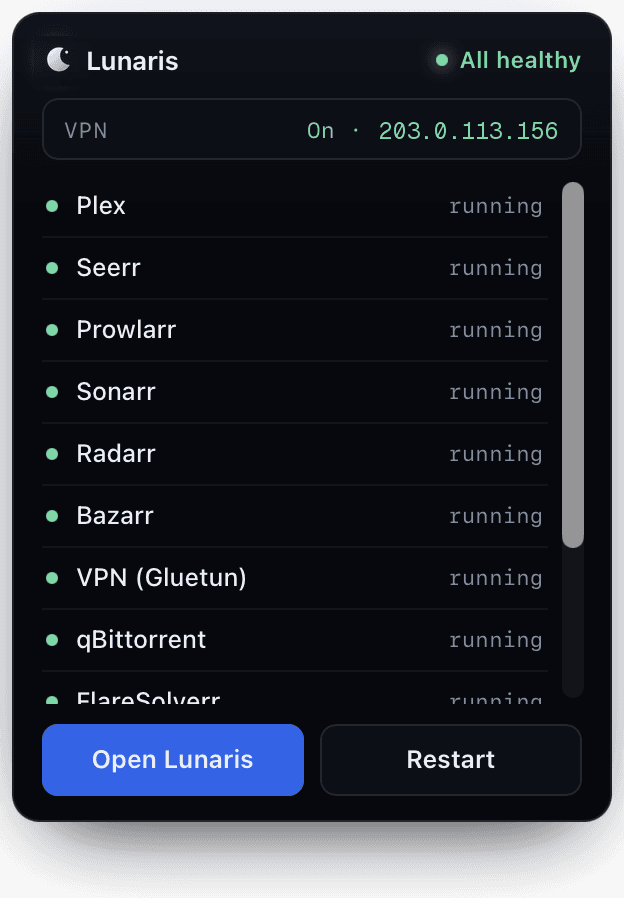
The Lunaris menu bar panel: every service with its status, the VPN line, and restart controls
At the Mac: the menu bar.
Anywhere else: your phone.

Always at a glance

One verdict,
wherever you are.

At the Mac, the crescent in your menu bar holds the whole story: every service, the VPN line, a restart button. Away from it, flip on remote access and Lunaris serves its own status page on your home network — which is how a Mac mini in a closet runs the entire stack with no monitor attached.

  • Remote access is off by default. The link carries its own key, so only people you share it with can open it
  • Start-at-login keeps the night shift on duty through reboots and power cuts
  • Library on an external drive or NAS? Lunaris reconnects it on its own, and refuses to start without it so nothing ever rebuilds onto the wrong disk

What happens when you press Add.

Every step of it, in the dark, without you.

  1. You press Add

    Browse in Discover, pick anything. That's your whole job.

  2. The best copy is found

    Indexers searched, releases scored against your quality rules.

  3. VPN · kill switch

    Downloaded in the tunnel

    Sealed inside the VPN with the kill switch armed. Nothing leaks.

  4. Named, filed, subtitled

    Renamed to match your library, sorted into place, subtitles fetched.

  5. Ready to watch

    It appears in Plex — or Jellyfin — on every device. Press play.

See everything Lunaris handles

Pay once. Own it for good.

Lunaris is a paid Mac app, and here's why that matters: a weekend of free scripts isn't the same as software that answers for the result.

It's maintained, not abandoned

A stack of services, a VPN, indexers, and constant updates make a moving target. Lunaris keeps them working release after release, so nothing rots the first time something upstream changes.

Buy once, no subscription

One payment, and every Lunaris 1.x update is included. Founders go further: the first 100 get every future version, majors included, free forever.

You own it

No subscription, no account that can lock you out of your own library. The app and everything in it are yours.

Founder tier · first 100
$29one-time · lifetime license

The price for the first 100 founders. After that it's $59.

  • The full Lunaris Mac app, Apple Silicon and Intel
  • Every future update included, major versions too
  • Self-healing setup and maintenance, handled
  • Runs headless: remote status page for screen-less Macs
  • Connect your AI: built-in MCP server for diagnosis by chat
  • Founder support and a say in the roadmap

Instant download after checkout, and no account to create. 14-day money-back guarantee.

The things people ask first

No. If you can install a Mac app, you can run Lunaris. It handles the parts that used to take Docker, the command line, and a free weekend, so there's little to set up before you're watching.

Under the hood Lunaris runs the same battle-tested open-source tools you'd pick yourself. The difference is it installs, wires together, secures, updates, and repairs them for you as a native Mac app, instead of handing you a compose file and a wiki. You get the power of the full stack without becoming its sysadmin.

Yes. It's standard Plex or Jellyfin and the usual *arr apps underneath, so all of their own settings are right there for you to change. Lunaris manages the plumbing and keeps everything healthy, it doesn't lock you out of the tools or hide them behind a wall.

Plex Pass is one piece. It plays your library beautifully, but it doesn't find, download, organize, or VPN-protect anything, and it doesn't set the whole system up for you. Lunaris configures and runs the entire stack (Plex or Jellyfin included) and keeps it healthy. Plex is the screen. Lunaris is everything behind it. Worth knowing: Plex now charges for streaming your library away from home, so if fully-free matters, pick Jellyfin in the wizard — remote streaming there costs nothing.

A Mac running macOS 13 or newer, and that's it to browse, organize, and stream. If you want Lunaris to download for you, you bring a ProtonVPN subscription (around $5/month) — Lunaris walks you through connecting it during setup and never lets downloads run outside it. Support for Mullvad and other WireGuard providers is coming; for now the setup wizard takes ProtonVPN. You can also skip the VPN at setup and add one later.

Yes. The downloader is sealed inside the VPN, so its traffic only leaves your Mac through the encrypted tunnel. If that tunnel drops, the kill switch cuts the downloader off the network — it stops instead of falling back to your real connection. On by default, nothing to configure. And you can save a backup provider: switch with one click, or let Lunaris switch automatically when the tunnel stays down.

That's the part Lunaris is built to handle on its own. It recovers most issues automatically: restarting crashed services, recovering stalled downloads, failing over if the VPN drops. For anything it can't fix alone, you can connect your own AI (Lunaris is an MCP server) to read status and logs and restart what's stuck, and founder support comes with early access.

Yes. Lunaris ships as an MCP server, so Claude Desktop or any app that speaks the Model Context Protocol can connect straight to your stack: read live status, pull service logs with secrets scrubbed out, and restart a stuck service. The connection is local to your Mac. No port, no token, nothing exposed to the network, and no path for the AI to touch your media.

Yes — that's a favorite setup. Turn on 'Start Lunaris at login' and remote access, and a Mac mini in a closet runs the whole stack unattended. Lunaris serves its own status page on your home network, so you check on it (and restart anything stuck) from your phone or laptop. Plex, Seerr, and the rest are already reachable from any browser in the house.

Yes to both, right from first-run setup. External drives are a one-click pick, and a NAS (Synology, TrueNAS, anything speaking SMB) connects with four fields on the same screen — your password goes in the Mac's keychain, Lunaris mounts the share itself and reconnects it after reboots. The smart part is the split: your movies and shows live on the share, while the databases that need a fast local disk stay on the Mac. And if the storage isn't reachable, Lunaris refuses to start the stack rather than quietly rebuilding your library on the wrong disk.

Yes. Lunaris is a tool, like a web browser or a torrent client. It doesn't host, provide, or point you to any content. What you download is your responsibility, and plenty of people run stacks like this for fully legal libraries: discs they've ripped, public-domain films, DRM-free purchases, and content from legitimate Usenet providers.

Nothing happens to your library. You pay once, there's nothing to cancel, and your files live on your own drive in standard formats. If you ever remove Lunaris, your media and the underlying apps stay exactly where they are. You're never renting access to your own movies.

Lunaris is a native Mac app, signed and notarized by Apple, and it ships as a universal binary: Apple Silicon (M1, M2, M3, and newer) and Intel Macs both run it, on macOS 13 or newer. Apple Silicon is the smoothest experience, especially when streaming to several devices at once. It's built for the Mac, not a port — and it doesn't run on Windows or Linux.

No catch. $29 is the price for the first 100 licenses, one-time, with the app and every future update included — no subscription, no account to create. When the hundredth license sells, the price becomes $59. The only catch is buying early.

Almost nothing. The app checks your license standing and looks for updates against our server — that's the whole conversation. No usage analytics, no crash reporters, and nothing about your library, your watching, or your downloads ever leaves your Mac. The license check even tolerates being offline for weeks, so a network hiccup never locks you out.

Stop babysitting your media server.

Start owning it.

Lunaris is out. $29 one-time for the first 100 founders, downloading a minute from now.

Buy Lunaris · $29